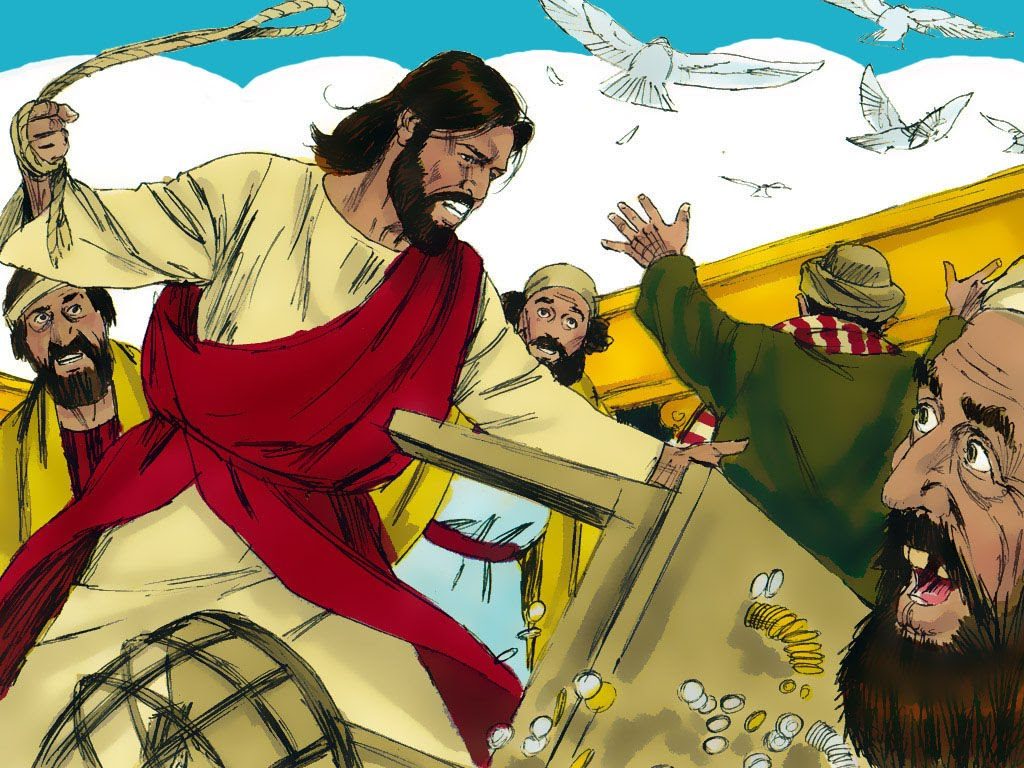
After the temple cleansing in John, did Jesus say he would resurrect himself?
Based on John 2:19, it is claimed that Jesus resurrected himself, but many scriptures say God the Father resurrected Jesus. Did Jesus resurrect himself? Let’s consider the immediate context in which Jesus spoke at John 2:19, as well as the remote context of the entire Bible.
John 2:19-21 —“Jesus answered them, ‘Destroy this temple, and I will raise it again in three days’ . . . the temple he had spoken of was his body” (NIV), referring to his death. Trinitarians claim Jesus resurrected himself, but how could that be? Did Jesus actually say that he would resurrect himself?read more
“Good Things That Are Now Already Here” For Christians!
Several incredible technological, environmental, and societal advancements are being touted as great things that are happening now in the world. On the other hand, Christians are often portrayed, or even made fun of, as drearily waiting for some kind of “pie-in-the sky” reward in the future. As Jesus candidly admitted, “in the world you have tribulation” (John 16:33 LSB). However, the Bible also itself tells us another side of the story. The New Testament tells us about the many “good things that are now already here” for Christians! How is this so, and what are some of these “good things that are now already here”? Are these “good things” possibly even better than what the world in general has to offer?read more
Were Books Omitted From the Old Testament of the Bible?
“All scripture is inspired by God” (2 Timothy 3:16 NAB). Increasingly claims are made that books were omitted from the Old Testament of the Bible. The Hebrew Scripture canon of inspired books was closed by circa 400 BCE, with the completion of the books of Nehemiah and Malachi. This means that any more books produced after that time were considered not inspired by God, according to the Jews. What evidence do we have that our current 39 book Old Testament doesn’t omit any inspired books?read more
The Bible is popularly viewed as a mixture of fact, fiction, and folklore. In this article, we will explore the subject of “When was the book of Lamentations written, and why is it important for us to know that?”
The relatively short five chapter Old Testament Bible book isn’t used very much these days. In fact, many Christians are unaware that the book even exists, and even many of those who are aware, would struggle to find its place in the Bible. This is ironic, because an older song often sung in Christian Church services, weddings and funerals, “Great Is Thy Faithfulness”, is based on Lamentations 3:22-23. read more
Who wrote the book of Revelation?
In the 3rd century African bishop Dionysius asserted that the Greek syntax, vocabulary, subject matter, style and themes of Revelation were so different from John’s gospel and letters, that Revelation had to have had a different writer. Modern skeptical scholars hold the same view. The Greek used in Revelation is quite different from the Greek used in John’s gospel and letters., so many skeptical scholars assert that the apostle John wasn’t the writer. Who wrote the book of Revelation?
EVIDENCE OF THE APOSTLE JOHN’S WRITERSHIP
The internal and external evidence debunks the theory that the apostle John wasn’t the writer, as we can see from the following:
“I am John, your brother, and as a follower of Jesus I am your partner in patiently enduring the suffering that comes to those who belong to his Kingdom. I was put on the island of Patmos because I had proclaimed God’s word and the truth that Jesus revealed” (Revelation 1:9 GNB). The writer identifies himself as the John with whom his contemporary readers are very familiar with. The apostle John being on the penal isle of Patmos very late in the 1st agrees with what is otherwise known about the apostle John.
“The revelation of Jesus Christ . . . He made it known by sending his angel to his servant John” (Revelation 1:1 NAB). John is identified in third person as being the human recipient of the revelation.
“Write down the things which you have seen, and the things which are, and the things which will take place after these” (Revelation 1:19 LSB). John is told to write down the revelation that he has seen, which places him as the writer.
‘I, John, am the one who was hearing and seeing these things” (Revelation 22:8 LSB). John identifies himself by name for the 3rd time in Revelation.
Revelation has many ideas and themes in common with John’s gospel and letters. Only John’s gospel and Revelation refer to Jesus as “the Word” (John 1:1; Revelation 19:13), and “the Lamb” (John 1:29; Revelation 5:6,13; 7:10,14; 22:7,9; 21:9; 22:1).
The word “witness” is one of the apostle John’s themes, appears about 180 times in the New Testament, about 80 of which are in John’s writings (48 in John; 12 in 1 John; 5 in 3 John; 14 in Revelation).
Writers are well known to use different styles when dealing with different subject matter. John’s gospel consists mostly of historical narratives, and his letters provide Christians truths and counsel. In the Revelation, he records what he was shown in apocalyptic visions. These are strangely esoteric, making the content of Revelation starkly different from John’s other writings. This, in itself, accounts for the different subject matter, syntax, and vocabulary.
CONCLUSION
We have examined powerful evidence in favor of John being the writer, notwithstanding the great differences between Revelation and john’s other four Biblical writings.
For more information, see the following related articles on this website:
Regarding any Bible teaching, we do well to ask, “Does scripture really say that?“
The Bible is “the word of God” (1 Thessalonians 2:13). However, there are “false teachers” (2 Peter 2:1 LSB), as well as “false doctrines” (1 Timothy 1:3), and “false prophets” that we need to “beware of” (Matthew 7:15). Regarding anything that is taught about the Bible, we do well to ask, “Does scripture really say that?“
BIBLE PRINCIPLES
“Examine all things; hold fast to that which is good” (1 Thessalonians 5:21 LSB). “The Greek word for “test” (δοκιμάζω) implies a rigorous examination, akin to testing metals for purity” (Bible Hub Study Bible). This involves some effort and work on the part of the individual, but eternal life is well worth it.
“Beloved, do not believe every spirit, but test the spirits to see whether they are from God, because many false prophets have gone out into the world” (1 John 4:1 LSB).“Testing the spirits involves discernment and evaluation of teachings and prophecies” (Bible Hub Study Bible). We’re to believe everything that is taught about the Bible, even by Bible scholars, but we’re told to “test” the teachings. What do we test the teachings against? — We have an example for us in the scriptures:
“These people were more receptive than those in Thessalonica. They were very willing to receive the message, and every day they carefully examined the Scriptures to see if those things were so” (Acts 17:11 ISV). “The Bereans’ daily examination of the Scriptures highlights their diligence and commitment to truth. This practice of daily study is a model for believers, emphasizing the importance of regular engagement with God’s Word. The Bereans did not take Paul’s teachings at face value but sought to verify them against the Hebrew Scriptures, which were the authoritative texts for them” . Most people do not want to put forth the time and effort to ‘examine the scriptures carefully every day’, and prefer to have someone else tell them what to think. Unfortunately, this, no doubt, is one of the reasons most people are on the figurative “road to destruction” (Matthew 7:13-14).
The scriptures themselves, in God’s Word, advise us, regarding anything that is taught about the Bible, we always do well to ask, “Does scripture really say that?“
EXAMPLES
Let’s look at some examples to illustrate the point of ‘examining all things by the scriptures’.
Example 1
Catholics claim: “Those that build their foundations on wood, grass or straw will be burned when we are purified to go to purgatory. Yet they will saved though only as men are saved by passing through fire. All people who go to purgatory will be saved though suffering (fire).”
THE BIBLE SAYS: Paul was using word pictures, such as metaphors, in the account at 1 Corinthians 3:10-17. He uses simile in verse 15 saying “the person will be saved, but ONLY AS THROUGH FIRE.” (Catholic New American Bible [NAB])
The fire is figurative for spiritual cleansing and difficulty prior to death, not after! Even the Catholic New American Bible (NAB) footnote on this verse admits: “THE TEXT OF V 15 HAS SOMETIMES BEEN USED TO SUPPORT THE NOTION OF PURGATORY, THOUGH IT DOES NOT ENVISAGE THIS.”
Example 2
“Within the One Being that is God, there exists eternally three coequal and coeternal persons, namely, the Father, the Son and the Holy Spirit”—The Forgotten Trinity, by James White, page 23
Where does the Bible say such a thing? — A comprehensive search of the Bible’s 31,100 scriptures reveals that it doesn’t!
Rather, it comes from Trinitarians “who are following their own imaginations” (Ezekiel 13:3 NLT).
Example 3
“Under God’s Kingdom arrangement, 144,000 anointed ones will serve alongside our High Priest, Jesus, as kings and priests. (1 Pt. 1:3,4; 2:9).—Watchtower Study Edition, 9-1-2026, “How the Priesthood Reveals Jehovah’s Love”, paragraph 9
When we actually read 1 Peter 1:3,4; 1 Peter 2:9 for ourselves, even from the Jehovah’s Witnesses own New World Translation, we find that the scriptures themselves say nothing about any “144,000 anointed ones”.
Example 4
“Which book of the Bible provides the most extensive and detailed teaching on the Trinity? . . . there is an Old Testament book that has more to say about the Trinity than the Gospel of John and Revelation combined–the two New Testament books that say the most about the Trinity. That book is Isaiah” —“Does the Book of Isaiah Teach the Trinity?”, Reasons to Believe (RTB) blogsite, by Hugh Ross, July 20, 2020read more