Skeptics and critics of the Bible often assert that Cain went to a distant land, and encountered an entirely different species of humans living there, and subsequently he settled down, and took a wife from among them. Critics claim these other people were not created by Yahweh, So, who was Cain’s wife? Where did she come from? Let’s look at the Biblical account:
BIBLICAL ACCOUNT
“Then Cain went out from the presence of Yahweh and settled in the land of wandering, east of Eden. Then Cain had relations with his wife, and she conceived and gave birth to Enoch; and he built a city and called the name of the city Enoch, after the name of his son” (Genesis 4:16-17 LSB margin). If we look closely at the text, we notice that it doesn’t say Cain encountered any other humans upon arriving in “the land of wandering, east of Eden”. Where did Cain’s wife come from then?read more
Who wrote the book of Revelation?
In the 3rd century African bishop Dionysius asserted that the Greek syntax, vocabulary, subject matter, style and themes of Revelation were so different from John’s gospel and letters, that Revelation had to have had a different writer. Modern skeptical scholars hold the same view. The Greek used in Revelation is quite different from the Greek used in John’s gospel and letters., so many skeptical scholars assert that the apostle John wasn’t the writer. Who wrote the book of Revelation?
EVIDENCE OF THE APOSTLE JOHN’S WRITERSHIP
The internal and external evidence debunks the theory that the apostle John wasn’t the writer, as we can see from the following:
“I am John, your brother, and as a follower of Jesus I am your partner in patiently enduring the suffering that comes to those who belong to his Kingdom. I was put on the island of Patmos because I had proclaimed God’s word and the truth that Jesus revealed” (Revelation 1:9 GNB). The writer identifies himself as the John with whom his contemporary readers are very familiar with. The apostle John being on the penal isle of Patmos very late in the 1st agrees with what is otherwise known about the apostle John.
“The revelation of Jesus Christ . . . He made it known by sending his angel to his servant John” (Revelation 1:1 NAB). John is identified in third person as being the human recipient of the revelation.
“Write down the things which you have seen, and the things which are, and the things which will take place after these” (Revelation 1:19 LSB). John is told to write down the revelation that he has seen, which places him as the writer.
‘I, John, am the one who was hearing and seeing these things” (Revelation 22:8 LSB). John identifies himself by name for the 3rd time in Revelation.
Revelation has many ideas and themes in common with John’s gospel and letters. Only John’s gospel and Revelation refer to Jesus as “the Word” (John 1:1; Revelation 19:13), and “the Lamb” (John 1:29; Revelation 5:6,13; 7:10,14; 22:7,9; 21:9; 22:1).
The word “witness” is one of the apostle John’s themes, appears about 180 times in the New Testament, about 80 of which are in John’s writings (48 in John; 12 in 1 John; 5 in 3 John; 14 in Revelation).
Writers are well known to use different styles when dealing with different subject matter. John’s gospel consists mostly of historical narratives, and his letters provide Christians truths and counsel. In the Revelation, he records what he was shown in apocalyptic visions. These are strangely esoteric, making the content of Revelation starkly different from John’s other writings. This, in itself, accounts for the different subject matter, syntax, and vocabulary.
CONCLUSION
We have examined powerful evidence in favor of John being the writer, notwithstanding the great differences between Revelation and john’s other four Biblical writings.
For more information, see the following related articles on this website:
The bodies of many dead people s were suddenly thrown from their tombs at the violent earthquake that occurred at Jesus’ death (Matthew 27:51-53). It is commonly thought that these people were resurrected. Were the bodies of these saints resurrected?
“At that moment the veil of the temple was torn in two from top to bottom. The earth quaked, and the rocks were split. The tombsbroke open, and the bodies of many saints who had fallen asleep were raised, After Jesus’ resurrection, when they had come out of the tombs, they entered the holy city and appeared to many people” (Matthew27:51-53 BSB).read more
Do The Three Years of Daniel 1:5 Contradict Daniel 2:1?
“Nebuchadnezzar king of Babylon came to Jerusalem and besieged it . . . The king said . . . to bring some of sons of Israel . . . to stand in the king’s palace . . . and teach them the literature and tongue of the Chaldeans . . . that they should be educated three years, at the end of which they were to stand before the king” (Daniel 1:2-5 LSB). Critics claim that the “three years” of Daniel 1:5 of educational training that Daniel and his three Hebrew companions received after coming to Babylon as captives conflict with their reported appearance, “before Nebuchadnezzar . . . in service before the king” by “the second year of the reign of Nebuchadnezzar” (Daniel 1:18,19; 2:1 LSB), since Nebuchadnezzar is called “king of Babylon” at the time of the capture of the Jews. They claim that the Bible’s account is fictional because it reports the three years of training as completed in only the second year of Nebuchadnezzar’s reign.read more
Samson is one of the more famous characters in the Bible, particularly known for his extraordinary acts of strength, and his encounter with Delilah. In one the less prominent events of his life, it is commonly believed by Bible scholars, Christians, and others, that the ancient Israelite judge Samson committed immorality with a harlot in the Philistine city of Gaza, based on the scriptural account in Judges 16:1-3. All one has to do is look at some of the numerous Bible commentaries to see this. Did Samson sin with the prostitute at Gaza?read more
The Gospel of Matthew was written anonymously, but was universally attributed to Jesus apostle Matthew, until the 1800’s. Today, most scholars, and skeptics and critics no longer believe this. Instead, they claim the Gospel of Matthew is based largely on the Gospel of Mark, which they assert was written first, and also on the totally speculative “Q” source. They claim, therefore, that Matthew is unlikely to have been written by one of Jesus closest followers, namely the former tax collector, and apostle of Jesus, Matthew Levi, but instead was written in the 80’s or 90’s CE by one or more second generation disciples. What does the evidence actually show as to when the Gospel of Matthew was written?read more
“The original of the letter (autograph) is not known to survive. Papyrus 46, the earliest reasonably complete version available to scholars today, dates to approximately AD 200, around 150 years after the original was drafted. Biblical scholars agree that Galatians is a true example of Paul’s writing. The main arguments in favor of the authenticity of Galatians include its style and themes, which are common to the core letters of the Pauline corpus. George S. Duncan described its authenticity as “unquestioned. In every line it betrays its origin as a genuine letter of Paul. A majority of scholars agree that Galatians was written between the late 40s and early 50s, although some date the original composition to c. 50–60.”—Wikipediaread more
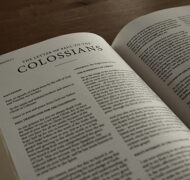
Who wrote Colossians? Google AI says this about Colossians:
“According to Bart Ehrman, the book of Colossians claims to be written by Paul the Apostle, but he argues that it is not genuinely Pauline; meaning he believes Paul did not actually write it. Ehrman, along with many other critical scholars, suggests that the letter was written by someone else, possibly a later follower of Paul, using Paul’s name.”
Let’s examine the relevant facts, to find out who wrote Colossians. Critics, such as Ehrman and others, have only their own speculative ideas from which they postulate. Compelling grounds for questioning the letter’s authenticity are lacking. Colossians contains autobiographical statements from Paul, and even opens with a salutation from Paul. read more
“Monogenēsmay be used as an adjective. For example, monogenēs pais means only child, only legitimate child or special child. Monogenēs may also be used on its own as a noun. For example, o monogenēs means “the only one”, or “the only legitimate child” . . . Some interpretations of the word “unique” attempt to preclude birth, yet the full Greek meaning is always in the context of a child (genes). A unique child is also a born child, hence the full meaning of the word “begotten” as found in John 3:16 (KJV), for example”—Wikipediaread more
The Bible accurately reports how a red sky in the evening means fair weather, but in the morning it means rainy weather. Does this weather phenomenon also tell us something else? Could it perhaps even tell us something much more important than the weather forecast?
“The Pharisees and Sadducees came to Jesus and tested him by asking him to show them a sign from heaven. He replied, ‘When evening comes, you say, “It will be fair weather, for the sky is red,”and in the morning, “Today it will be stormy, for the sky is red and overcast.” You know how to interpret the appearance of the sky, but you cannot interpret the signs of the times. A wicked and adulterous generation looks for a sign, but none will be given it except the sign of Jonah'”—Matthew 16:1-4 NIVread more

.jpg)