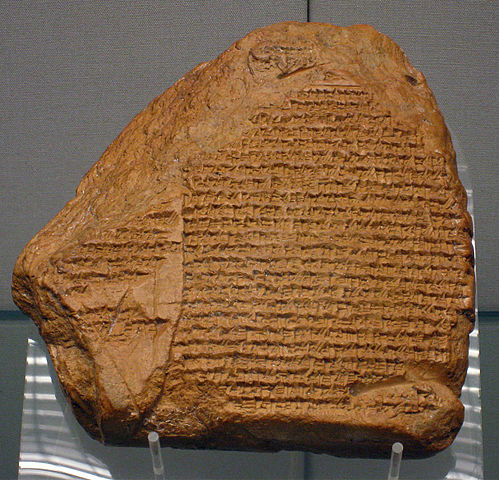
“In the fifteenth year of Tiberius Caesar–when Pontius Pilate was governor of Judea”—Luke 3:1 NIV
Pontius Pilate is mentioned in all four the the gospels, Matthew, Mark, Luke and John, and in Acts and 1 Timothy, as the Roman governor before whom Jesus was brought to trial, and who, under pressure, passed the death death sentence upon Jesus (Matthew 27:1-26; Mark 15:1-15; Luke 22:66-23:25; John 18:28-19:16; Acts 4:27; 13:28; 1 Timothy 6:13). Pilate was “governor of Judea” from 26 CE to 36 CE, and is mentioned by the writer Tacitus.read more
Are Bible dates accurate? In contrast to many other religious works, such as The Koran, Hindu writings, Buddhist, Confucian, the Apocryphal Books, the Book of Mormon, The Pearl of Great Price, Doctrines and Covenants, etc., for example, the Bible has a number of dates that can be cross-checked with surviving ancient records and accurately related to our modern calendar and proven to be accurate. These Bible dates
How do we know that Bible dates are accurate?
are just some of the ways that the Bible has proven to accurate, authentic and genuine. Some examples follow.read more
Did Ahab begin as a good king, and turn bad, or was he always a bad king??
It has been said, and even preached in church, that Ahab started out as a good king because of the names he gave his two sons, and later turned bad. Ahaziah means “Yahweh grasps [his hand]” (1 Kings 22:51), and Joram (Jehoram) means “Yahweh is exalted” (2 Kings 1:17; 3:1-3). On the surface, it may appear that Ahab must have been good when his sons were born, because he gave them names that exalt and praise the true God Yahweh. However, many others in the Bible who were not good people also named their children names exalting and praising Yahweh. Simply giving a child a good name does not mean the parent[s] is/are good.read more
What do we learn from the city gate discovered at ancient Shiloh?
A city gate at Shiloh, an ancient Israelite city, has been discovered. What is the import of such a discovery.
“When he mentioned the ark of the God, Eli fell backward off his chair by the side of the city gate.His neck was broken and he died, for he was an old man, and he was heavy. He had led Israel forty years”—1 Samuel 4:18 NIV
The remains of a city gate were discovered recently in Shiloh, Israel. This was the place where the Ark of the Covenant was kept during the time of the Judges. The remains of this city gate gate were discovered by the Associates for Biblical Research along the northern wall of this ancient Israelite city. The team discovered that the defensive embankment against the city wall had a gap at this point, where the remains of the gate were discovered. The terrain leading up to this place was internally terraced upward., and “the city gate” being at this location also makes sense because the main spring that the city’s inhabitants used was located about a kilometer to the north. It is possible that this was “the city gate” where “Eli fell backward off his chair . . . and he died”.
CONCLUSION
The city gate discovered at Shiloh is just one more example of the thousands of evidences discovered, which independently verify many places and things that are mentioned in the Bible. This mountain of evidence stands in stark contrast to the Book of Mormon, which names many places, things, civilizations, and events, that supposedly existed or happened in the Americas, but have never been independently verified with even the slightest shred of evidence.
The more time that goes by, the more the truth of the Bible, as God’s infallible word, is confirmed.
“All mortals are like grass, and all their glory is like the flower of the field, the grass withers and the flower falls, but the word of the Lord endures forevermore” (1 Peter 1:24,25 REB).read more
Artifacts discovered confirm some of the detailed facts the Bible mentions about Israelite king Omri.
Like many other ancient sacred books upon which religions are based, the Bible has been criticized as being largely a work of fiction and myth. However, many discoveries have proven otherwise. Archaeological documents mentioning Israelite king Omri, have been discovered, and have added to the growing mountain of evidence favoring the Bible’s authenticity.
“Then the people of Israel were split into two factions; half supporting Tibni son of Ginath for king, and the other half supported Omri. But Omri’s followers proved stronger than those of Tibni son of Ginath. So Tibni died and Omri became king. In the thirty-first year of Asa king of Judah, Omri became king of Israel, and he reigned twelve years, six of them in Tirzah. He bought the hill of Samaria from Shemer for two talents of silver and built a city on the hill, calling it Samaria, after Shemer, the name of the former owner of the hill. But Omri did evil in the eyes of the LORD [Yahweh] and sinned more than all those before him. He followed completely the ways of Jeroboam son of Nebat, committing the same sin Jeroboam had caused Israel to commit, so that they aroused the anger of the LORD [Yahweh], the God of Israel, by their worthless idols. As for the other events of Omri’s reign, what he did and the things he achieved, are they not written in the book of the annals of the kings of Israel? Omri rested with his ancestors and was buried in Samaria. and Ahab his son succeeded him”—1 Kings 16:21-26 NIVread more
RATION TABLETS of JEHOIACHIN VERIFY BIBLE’S ACCURACY
Ration tablets of Jehoiakim in ancient Babylon have discovered
Cuneiform documents of ration tablets of Jehoiachin have been discovered at the site ancient Babylon.
“In the thirty-seventh year of the exile of Jehoiachin king of Judah, in the year Awel-Marduk became king of Babylon, on the twenty-fifth day of the twelfth month, he released Jehoiachin king of Judah and freed him from prison. He spoke kindly to him and gave him a seat of honor higher than those of the other kings who were with him in Babylon. so Jehoiachin put aside his prison clothes and for the rest of his life ate regularly at the king’s table. Day by day the king of Babylon gave Jehoiachin a regular allowance as long as he lived, till the day of his death”—Jeremiah 52:31-3NIV; see also 2 Kings 25:27-30read more
What is the significance of the Thessalonian politarch inscription?
What is a “politarch”?
“But when they did not find them, they dragged Jason and some other believers before the city officials [Greek, politarches], shouting: ‘These men who have caused trouble all over the world have now come here, and Jason has welcomed them into his house. They are all defying Caesar’s decrees, saying that there is another king, one called Jesus.’ When they heard this, the crowd and the city officials [Greek, politarches] were thrown into turmoil”—Acts 17:6-8 NIVread more
Ivory Discovered at Samaria and Nimrud Confirm Bible Accounts
Ivory discovered by archaeology at Samaria and Nimrud confirm what the Bible says.
Ivory discovered at the sites of ancient Samaria and Nimrud confirm some of the details mentioned in the Bible about the material prosperity experienced during the latter part of the northern kingdom of Israel.
“All people are like grass, and all their glory is like the flowers of the field; the grass withers and the flowers fall, but the word of the Lord endures forever”—1 Peter 1:24,25 NIV
The Bible documents the age-old trade and use of ivory. The unified 12 tribe kingdom under Solomon’s peaceful 40 year reign gained great material prosperity. read more
Evidence of the Great Earthquake in Amos & Zechariah
Is there any external evidence of the great earthquake in Amos and Zechariah?
Critics have claimed the Bible is mostly fiction, including the great earthquake referred to in the Bible books of Amos and Zechariah.
“The words of Amos, one of the shepherds of Tekoa–the vision he saw concerning Israel two years before the earthquake, when Uzziah was king of Judah and Jeroboam son of Jehoash was king of Israel”—Amos 1:1 NIV).
RECENT GEOLOGICAL DISCOVERY
Recent geological studies have detected a massive seismic event, apparently a huge 8.2 earthquake, in the area where Amos lived. This event, which has been dated to around 760-750 BCE, which was during the latter part of the long reign of Judean king Uzziah (792–740 BCE), and was the largest ever detected on the Dead Sea Transform Fault. read more
The Bible warned the ancient Israelites to avoid Asherah and Baal worship
Critics say the Bible is not as ancient as it claims to be, and is often not historically accurate. God’s chosen people were warned against the worship of the pagan fertility false goddess Asherah prior to entering the promised land. “You do not plant an Asherah of any trees for yourself near the altar of your God YHWH, which you make for yourself” (Deuteronomy 16:21 LSV). Archaeological evidence discovered in ancient Israel provides ample evidence confirming such Asherah worship.read more