“The original of the letter (autograph) is not known to survive. Papyrus 46, the earliest reasonably complete version available to scholars today, dates to approximately AD 200, around 150 years after the original was drafted. Biblical scholars agree that Galatians is a true example of Paul’s writing. The main arguments in favor of the authenticity of Galatians include its style and themes, which are common to the core letters of the Pauline corpus. George S. Duncan described its authenticity as “unquestioned. In every line it betrays its origin as a genuine letter of Paul. A majority of scholars agree that Galatians was written between the late 40s and early 50s, although some date the original composition to c. 50–60.”—Wikipediaread more
Who wrote Colossians? Google AI says this about Colossians:
“According to Bart Ehrman, the book of Colossians claims to be written by Paul the Apostle, but he argues that it is not genuinely Pauline; meaning he believes Paul did not actually write it. Ehrman, along with many other critical scholars, suggests that the letter was written by someone else, possibly a later follower of Paul, using Paul’s name.”
Let’s examine the relevant facts, to find out who wrote Colossians. Critics, such as Ehrman and others, have only their own speculative ideas from which they postulate. Compelling grounds for questioning the letter’s authenticity are lacking. Colossians contains autobiographical statements from Paul, and even opens with a salutation from Paul. read more
Roman Governor Felix Account Confirms Bible’s Authenticity
“Several days later Felix came with his wife Drusilla, who was Jewish. He had Paul summoned and listened to him speak about faith in Christ Jesus. But as he spoke about righteousness and self-control and the coming judgment, Felix became frightened and said, ‘You may go for now; when I find an opportunity I shall summon you again'” (Acts 24:23-24NAB). What strikes us here as being highly unusual, is that the powerful Roman governor of Judea, M. Antonius Felix became frightened while listening to the prisoner Paul speak in a hearing before him. One would naturally think that Paul should be the one who is frightened, not Felix. So, the question naturally arises, why did Roman Governor Felix become frightened listening to Paul? read more
Paul’s Roman Citizenship, Governor Felix, and Bribery
What do Paul’s Roman citizenship, Governor Felix, and bribery have to do with the Bible’s authenticity? M. Antonius Felix was the 4th Roman governor of Judea, from 52-60 CE, and well known for taking bribes and other corruption. The apostle Paul, who was in custody, came before him in “trial”, and after hearing both sides of the issue, “Felix . . . postponed the trial” (Acts 24:21,22 NAB). Why?
“Felix . . . hoped that a bribe would be offered him by Paul, and so sent for him very often and conversed with him. Two years passed” (Acts 24:25,26 NAB). Felix’ hope for a bribe from Paul seems highly unusual, not because of any honesty on Felix’s part, but because of Paul’s poverty. To support himself, Paul, at times, did manual labor as a part-time ‘tentmaker’ (Acts 18:3). Due to his intense focus on spreading the gospel and his itinerant travel, at times he didn’t even have the basic necessities of life (2 Corinthians 11:27). read more
Skeptics and critics frequently claim that the Bible is full of contradictions. One of them is about who heard Jesus’ voice on the Damascus road. Here it is:
When Paul was on the road to Damascus he saw a light and heard a voice, did those who were withhim hear the voice? (a) Yes (Acts 9: 7) (b) No (Acts 22: 9)
Many Bible translations do not precisely translate the Greek, which makes it appear that there really is a contradiction as to who heard Jesus’ voice. However, this supposed “contradiction” is easily cleared up when we look at an accurate translation of the verses under examination.read more
Gallio Inscription & the Bema Confirm Historical Accuracy of Acts
The historical accuracy of Acts has been confirmed
The historical accuracy of Acts has been questioned, and asserted to be inaccurate. Many discoveries have confirmed the historical accuracy of Acts, two of which are the Gallio Inscription and the Bema in ancient Corinth.
“Paul stayed in Corinth for a year and a half, teaching them the word of God. While Gallio was proconsul of Achaia, the Jews of Corinth made a united attack on Paul and brought him to the place of judgment”—Acts 18:11-12 NIV
The Gallio Inscription, consists of nine fragments found near the Temple of Apollo in Delphi, Greece, in 1908, mentions “Lucius Junius Gallio, my friend, and the proconsul of Achaia.” It is a copy of a letter from Roman Emperor Claudius and indicates that Gallio was the proconsul of Achaia at the time. The inscription further states that Claudius was confirmed Emperor for the 26th time, which dates it to late April/early May of the year 52 CE.read more
Who wrote Hebrews? In thirteen New Testament letters, or epistles, Paul introduces himself as the writer. However, the writer of Hebrews is anonymous. Hebrews was accepted as an epistle of Paul by early writers, and throughout most of Christian history, the apostle Paul was viewed as the writer of Hebrews. However, in the last couple of hundred years, this view has been dismissed by many of the “experts.” What are the facts? Who wrote Hebrews?
Regardless of who who wrote the Letter to the Hebrews, the important thing to remember is that this writing, like the Old Testament before it, is what “the holy Spirit says” (Hebrews 3:7NAB). The fact that the writer does not identify himself by name in the letter does not prove that Paul isn’t the writer. Many Old Testament Bible books don’t name the writer, and neither do the Gospels and Acts in the New Testament.
Differing Views of Writership
Most “scholars” and “experts” these days, especially since the 1800’s, do not think that the Christian apostle Paul wrote Hebrews. This view stands in contrast to the early Christians, who almost unanimously held the view that Paul wrote Hebrews, even though the writer isn’t named in the book itself.
“As early as the end of the second century the church of Alexandria in Egypt accepted Hebrews as a letter of Paul, and that became the commonly held view in the East. Pauline authorship was contested in the West in the fourth century, but then accepted. In the sixteenth century, doubts about that position were again raised, and the modern consensus is that the letter was not written by Paul. There is, however, no widespread agreement on any of the other suggested authors, e. g., Barnabus, Apollos, or Priscilla and Aquila. The document itself has no statement about its author”—Introduction to The Letter To The Hebrews, New American Bible (NAB)read more
Are God, Jesus, and the Holy Spirit a Trinity in 2 Thessalonians?
In the Bible book of 2 Thessalonians, the Apostle Paul speaks of God, Jesus Christ, and the holy Spirit. If Paul and/or the early Christians believed Jesus is God or part of a Trinity, we should be able to find evidence of this in the New Testament letters. But is this the case in 2 Thessalonians? Is the Trinity in 2 Thessalonians? Let’s examine some of the pertinent verses to find out.
Paul speaks of both God, Jesus, and the holy Spirit in 2 Thessalonians. But does he believe God is a Trinity?
=&0=&
Is The Trinity In Ephesians? Is Jesus Christ Almighty God?
This article is one of a series about what is stated concerning Jesus in the various books of the New Testament, the book of Ephesians. Almighty God and the holy Spirit are also discussed to see if there is any evidence of a Trinity doctrine in this Biblical letter, which is all about doctrine. A key component of the Trinity doctrine is that the holy Spirit is a person. In this article, we’ll see whether the Trinity is in Ephesians.
The Book of Ephesians provides some clues as to whether or not Jesus Christ is Almighty God
Ephesians 1:1,2 – “…an apostle of Christ Jesus by the will of God . . . from God our Father and the Lord Jesus Christ” God are Jesus are separate individuals as we can see from this scriptural text. “To God’s holy people in Ephesus… in the Lord Jesus Christ.” Notice how many times in this letter God and Jesus are both mentioned, but as separate and distinct persons, with God being superior, the “greater” (John 14:28), and Jesus as inferior. Paul is “an apostle of Jesus Christ by the will of God”! Why is it not God’s will that Paul also be an apostle of the holy Spirit, or the Trinity? Why is the letter not also from the holy Spirit or the Trinity? It’s because the holy Spirit is not a person, and the Trinity isn’t in Ephesians, nor does it exist!
Ephesians 1:3 – “…to the God and Father of our Lord Jesus Christ.” This verse clearly indicates that Jesus has a God over him. This God of Jesus is his Father. Someone who has God over him cannot be God. The fact that Jesus is called “Lord” obviously doesn’t make him God. This is further confirmed by other scriptures, such as, “the God and Father of our Lord Jesus Christ” (2 Corinthians 1:3), “God, your God” (Hebrews 1:9), “his God and Father” (Revelation 1:6).
Ephesians 1:5-7 – “God decided in advance to adopt us into his own family by bringing us to himself through Jesus Christ . . .we praise God for the glorious grace he has poured out on us who belong to his dear Son. He is so rich in kindness and grace that he purchased our freedom with the blood of his Son and forgave our sins” ” (NLT). God, as superior, is obviously calling the shots, operating through his Son Jesus Christ. Almighty God the Father, who is the one in control, gave Jesus as redeemer of sinful humans. God, the purchaser, “purchased our freedom with the blood of his Son”. This means that “Christ died” (1 Corinthians 15:3), whereas “God . . . will not die” (Habakkuk 1:12 NIV). As the famous scripture says, “God so loved the world that He gave His only begotten Son” (John 3:16 LSB). “God” is clearly shown to be someone other than “his Son”.
Ephesians 1:9,12 – “He [God] made known to us the mystery of his will according to his good pleasure, which he purposed in Christ.”(NIV). “God’s purpose was that we Jews who were the first to trust in Christ would bring praise and glory to God” (NLT). God is the one who decided in advance what was going to happen, in Christ. God “purposed in Christ”, meaning he is the one in control, not Christ. God is shown to be someone other than Christ. These verses emphasizes the fact that Almighty God is the one who is in total control. We don’t find the Trinity in Ephesians.
Ephesians 1:13,14 – “You . . . were sealed with the promised holy Spirit, which is the first installment of our inheritance toward redemption as God’s possession, to the praise of his glory” (NAB). Most translations translate the Greek word “ho” as “who”, after the word “Spirit”, to convey the idea that it is a person, due to Trinitarian bias. However, here, believers are “sealed” with the holy Spirit, which is referred to, not as a person, but as an “installment”. An “installment” cannot be a person, in contrast to the Trinity doctrine, which declares the holy Spirit to be a person. The NAB accurately renders the Greek “ho” as “which”, instead of “who”. Without the holy Spirit being a person, the Trinity doctrine collapses.
Ephesians 1:15,17 – “Your faith in the Lord Jesus and your love for all God’s people . . . that the God of our Lord Jesus Christ, the glorious Father” (NIV). Once again, God is shown to be someone other than Jesus. Who is the God of Jesus? – His Father! Someone who has God over them cannot be God. Therefore Jesus cannot be God. Without Jesus being God, the Trinity doctrine collapses, and the Trinity is absent from Ephesians.
=&0=&– “He raised Christ from the dead and seated him at his right hand in the heavenly realms . . . God placed all things under his [Jesus’] feet and appointed him [Jesus] to be head” (NIV). God, the superior one, resurrected Jesus, who “was dead” (Revelation 1:18). “Christ died” (1 Corinthians 15:3), but “God” cannot “die” (Habakkuk 1:12 NIV). “God” then placed “Christ . . . at his right hand”, which means Christ can’t be God.. Since God put all things under Jesus and appointed Jesus head of the church, God is obviously more powerful, that is, “greater than” Jesus (John 14:28). God is obviously someone other than Christ. These verses eliminate (1) the “Jesus is God” claim; (2) the eternity claim; and (3) the equality claim of Trinitarianism. Without these key components, the Trinity dogma is vanquished!
Ephesians 2:4-7 – “God… made us alive with Christ.” “God raised us up with Christ.” “That… he might show… his grace… expressed… in Christ Jesus.” God is the one in charge and uses Christ to accomplish his purposes. God is presented by the scriptures as being supreme, and in total control of Jesus Christ, and is more powerful, that is, “greater than” Jesus (John 14:28). God is shown to be someone other than Christ. These verses eliminate both the eternity and equality claims of the Trinity dogma. We don’t find the Trinity in Ephesians.
Ephesians 2:18 – “It is through him we both have access in one Spirit to the Father” (ESV). “Access” to God the Father is gained, not only “through” Jesus Christ (John 14:6), and but also “in” the holy Spirit. “In one Spirit” indicates the holy Spirit is not a person. God operates “through” Jesus Christ to give his worshippers access to himself by means of the holy Spirit. This scripture presents God as superior to Christ (John 14:28), and the holy Spirit as being inanimate. This verse eliminates both the eternity and equality claims of the Trinity dogma.
Ephesians 2:20,22 – “built . . . with Christ himself as the chief cornerstone . . . in him you too are being built together to become a dwelling in which God lives by his Spirit” (NIV). In this metaphor, Christ is part of the building that God lives in. Who is greater? Part of the building, or the One who owns and lives there? – Obviously, the owner, who is also the resident, God the Father, is greater than the building, or any part of it, namely his Son, Jesus Christ. Also, the holy Spirit is referred to as ‘God’s Spirit’, indicating that it is not a person. This is powerful evidence that God the Father is much “greater than” Jesus Christ (John 14:6). Without equality between the Father and the Son, and without the holy Spirit being a person, the Trinity doctrine collapses under the weight of the scriptures.
Ephesians 3:8-9,11 – “Proclaiming . . . the good news of the unfathomable riches of Christ. . . of bringing to light how this hidden purpose was to be put into effect. It lay concealed for long ages with God the Creator of the universe . . . This accords with his age-long purpose which he accomplished in Christ Jesus our Lord” (REB). “God the Creator” owns and controls “the unfathomable riches of Christ.” Paul says that God revealed ‘this age-long hidden purpose’ by using Christ, again indicating that God “the Father is greater than” his Son, Jesus Christ (John 14:28).”God the Creator” is obviously the one who is in control, not “Christ Jesus”.
Ephesians 3:11-12 – “Christ Jesus our Lord, in whom we have freedom of access to God, with the confidence born of trust in him” (REB). “God” is presented as someone other than “Christ Jesus”. Approach, or access, to “God” is through “Christ Jesus” (John 14:9). “The phrase underscores the exclusivity of Christ as the mediator between God and humanity (1 Timothy 2:5)” (Bible Hub Study Bible). “The mediator between God and humanity” obviously cannot be God. God is clearly “greater than” Jesus (John 14:28). Without the Son of God, Christ Jesus being God, and without equality between them, the pillars of the Trinity are removed.
Ephesians 3:14-15 – “For this reason I kneel in prayer to the Father, from whom every family in heaven and on earth takes its name”(REB). Paul ‘kneels’ in reverent submission and prayer to the heavenly Father, as superior, even over Jesus. In Ephesians, “God” is identified as “the Father of our Lord Jesus Christ” (Ephesians 1:3). Although Trinitarians often pray to Jesus, there is no Biblical direction to do so, nor are there any Biblical examples of anyone doing so . Jesus himself directed his disciples, including us, to pray to “our Father in heaven” (Matthew 6:9), not to the Son, or the holy Spirit, or Trinity. “Every family: in the Greek there is wordplay on the word for the Father (patria, pater). The phrase could also mean ‘God’s whole family’ (cf. 2:21). ‘Every family’s name’ comes from the God Father, not the Son, not the holy Spirit, or the Trinity
Ephesians 3:16-17– “I pray that out of his glorious riches he may strengthen you with powers through his Spirit in your inner being, so that Christ may dwell in your hearts through faith” (NIV). As Paul continues his prayer, he prays that God the Father may strengthen the Ephesian Christians through his Spirit, that Christ may be in their hearts through faith. The holy Spirit is thus identified as God’s Spirit, which indicates it is not a person. “The holy Spirit” (Luke 12:12 NAB) is “the Spirit of your Father” (Matthew 10:20), so it can’t be a person. Without the holy Spirit being a person, the Trinity doctrine collapses.
Ephesians 3:19 – “That you may be filled with all the fullness of God” (ESV). Trinitarians assert that since ‘Christ has all the fullness of God’ (Colossians 2:9), that he’s God. But, in their eagerness to support their dogma, Ephesians 3:19 goes right over their heads. Ephesians 3:19 tells us that Christians can also be “filled with all the fullness of God”. So, if we follow the same Trinitarian reasoning that they use for Colossians 2:9, Ephesians 3:19 makes Christians God as well, which is obviously absurd! Thus, by referencing and reasoning on all the scriptures, we can see that Christ cannot be God.
Ephesians 3:20-21 – “Now to him who is able to do immeasurably more than all we ask or imagine, according to his power that is at work within us, to him be glory in the church and in Christ Jesus.” (NIV) God, the one ‘who can do infinitely more than all we ask or imagine’, is the one is in control with all power, and who gives Jesus power. Revelation 21:22 shows us that “the Lamb”, Jesus Christ, is not “the Lord God Almighty”. Once again, we see more evidence here in Ephesians 3:20-21, in fact the entire Bible, that there is no equality between God the Father and Jesus. Without equality, the Trinity doctrine collapses.
Ephesians 4:5-6 – “one Lord, one faith, one baptism, one God and Father of all.”(ESV) Jesus is the “one Lord” here, and Yahweh, his Father, is the “one God.” The Greek word “one” here is “heis”, meaning the numeral “one”, which eliminates the possibility that either God or Jesus could be more than one person. They are each only one person. Together they make up “two” persons (John 8:17,18), but not one “substance”, “being”, or “essence”. A key takeaway from this verse is that the “one God” does not include the “one Lord”, who is Jesus Christ. Without Jesus being God, the Trinity doctrine collapses, and we can’t find the Trinity in Ephesians.
Ephesians 4:13 – “And of the full knowledge of the Son of God . . . to the measure of stature which belongs to the fullness of Christ.” (LSB) Notice that here, as elsewhere in the Bible, “Christ” is referred to as “the Son of God”, and not “God the Son,” a Trinitarian term which is never used in the Bible. Trinitarians teach and preach “a different Jesus” (2 Corinthians 11:4 NLT), who has been “fully God from eternity”. But the Bible says “Jesus of Nazareth, was a man accredited by God” (Acts 2:22 NIV), God’s “only begotten Son” (John 3:16 LSB). Being “accredited by God” means Jesus can’t be God, and being God’s “only begotten Son” means his life had an “origin” (Micah 5:2 NRSV), whereas Almighty God the Father has existed “from eternity” (Psalm 90:2 NAB). So the Trinity isn’t in Ephesians.
Ephesians 4:30 – “And do not grieve the h=&13=&The language here, “the holy Spirit of God, WITH which you were sealed”, strongly suggests the holy Spirit is not a person. This is not the type of language, or description, of a person. “The holy Spirit” (Luke 12:12 NAB), is “the Spirit of God” (Matthew 3:14), which is also “the Spirit of your Father” (Matthew 10:20), and not a person, as Trinitarians assert. This is very similar to the statement, “Yahweh . . . was grieved in His heart” (Genesis 6:6 LSB). The holy Spirit is not God, but represents Yahweh God, the Father. Without the holy Spirit being a person, the 3-in-1 Trinity doctrine collapses.
Ephesians 4:31; 5:2 – “Just as in Christ God forgave you . . . Just as Christ loved us and gave himself up for us as a fragrant offering and sacrifice to God.” (NIV) Almighty God forgives those who are “in Christ.” God forgives us through Christ. “God” is mentioned as being someone other than Christ, since ‘Christ offered his sacrifice to God’. The inferior offers the sacrifice to the greater, that is, Christ offered himself as a sacrifice to God. “Christ died for our sins” (1 Corinthians 15:3), but “Yahweh . . . God . . . never dies” (Habakkuk 1:12 NJB).Therefore, Jesus cannot be Almighty God, and the Trinity isn’t in Ephesians.
Ephesians 5:5,20 – “In the kingdom of Christ and of God . . . Always giving thanks to God the Father for everything, in the name of our Lord Jesus Christ.” (NIV) “Of Christ and of God”, means that here we have both shown to be two entirely separate and distinct individuals, who are not of the same “being”, “substance”, or “essence”. The titles “Christ” and “Father” clearly distinguish their distinct personages and roles. Notice that thanks are given in prayer to “God the Father”, as the Almighty God that he is, “through” (John 14:6) “the name of our Lord Jesus Christ”, the Son of God, but inferior to God the Father, who is “greater” (John 14:28).
“The husband is head of the wife, as the Christ also is head of the church” (Ephesians 5:23 LSB). Are Christians equal to Christ? Hardly! Just as the husband is the authority over his wife, the “captain of their salvation” (Hebrews 2:10 NKJV), has authority over Christians. Indeed, the scriptures are very clear that, “Christ has authority over every man, a husband has authority over his wife, and God has authority over Christ” (1 Corinthians 11:3 GWT). Christ’s authority is not equal to God’s authority. As Jesus himself said, “the Father is greater than I am” (John 14:28 GWT), thus debunking the equality assertion of Trinitarianism.
Ephesians 6:11-12 – “Put on the full armor of God, so that you may be able to stand against the rulers, against the schemes of the devil. For our struggle is not against the flesh and blood, but against the rulers, against the authorities, against the world forces of this darkness, against the spiritual forces of wickedness in the heavenly places” (LSB). Satan and his demons are organized in the spirit world to divert people’s worship away from “the only true God”, Yahweh the Father (John 17:1,3; Matthew 4:10 LSB margin; John 4:23) to other gods. These include not only pagan gods and goddesses, but also to the Trinity of Christendom, and to God’s Son, Jesus Christ. “The god of this age has blinded the minds of the unbelieving” (2 Corinthians 4:4), as well as the believing “to an unknown god” (Acts 17:23), that is, one “unknown” to the 1st century church (Jude 4; Ephesians 3:10).
Ephesians 6:6,23 – “As slaves of Christ, doing the will of God from your heart. Peace . . . and love with faith from God the Father and the Lord Jesus Christ.” (NIV) “Christ” and “God” are clearly distinguished, as separate individuals. Notice that Christians are “doing the will of God”, not ‘the will of Christ’, which emphasizes the superiority of God over Christ (John 14:28). Paul imparts love from God “and” Jesus as separate individuals working together, but not from the holy Spirit. Why? Because the holy Spirit is not a person. Without equality between God and Christ, and the holy Spirit being a person, the Trinity doctrine collapses.
CONCLUSION
So as we can see from Paul’s Letter to the Ephesians, there is a definite distinction drawn between Jesus and God. We even find reference in the Book of Ephesians to “the God of” Jesus. This means that God is superior to Jesus, so Jesus could not be Almighty God. Additionally, the holy Spirit is shown not to be a person, which, in itself, eliminates the Trinity doctrine.
The Trinity is not found in Ephesians.
For more information related to this subject, please see the following article on this website:
“Is the Trinity in Philippians? Is Jesus Christ Almighty God?” –
https://bibleauthenticity.org/trinity-jesus-christ-god-philippians/read more
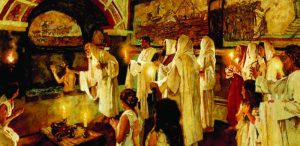
Today, Christians are called by such names as, Catholics, Orthodox, Protestants, Baptists, Pentecostals, Methodists, Episcopalians, Presbyterians, Lutherans, and many other names. But, according to the Bible, what name should Christians really be called, and why? How long has the term “Christian” been in use, and who invented it? The answer to these questions can be found in the Bible.
“It was in Antioch that the disciples were first called Christians” (Acts 11:26 NAB). God was behind the development of the use of the term “Christians” within a few years of the start of Christianity. Notice how this verse can also be rendered: “the disciples also were divinely called first in Antioch Christians” (Young’s Literal Translation).
Years later, at Paul’s final hearing before Roman governor Festus, the governor asked:
“Do you think you can persuade me to become a Christian so quickly?” (Acts 26:28 NLT)read more