Charred En-Gedi Scroll Manuscript is One of Oldest of the Torah
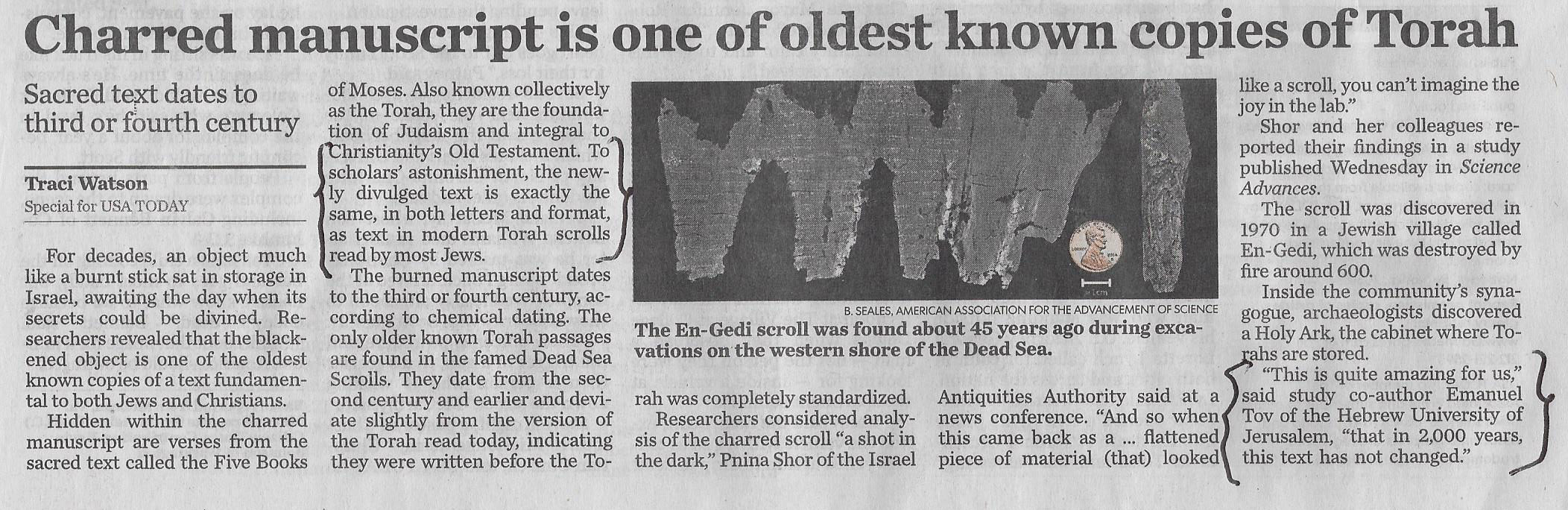
Has the Bible has been changed? Through many hundreds of years of hand-copying worn-out scrolls, the Bible did not change. The En-Gedi scroll, discovered in 1970, and featured in the article above, is just one of many proofs of this fact.
WHAT IS THIS SCROLL?
The En-Gedi Scroll contains verses from the beginning of the Biblical Book of Leviticus, specifically Leviticus 1:1-9 and Leviticus 2:1-11.
Found in 1970 inside the Holy Ark of an ancient synagogue at En Gedi, Israel, but left unread for decades because it was badly burned and charred into a fragile lump. Advanced 3D scanning and virtual unwrapping technology successfully read the text without physically opening it.
The En-Gedi parchment scroll of some verses of the book of Leviticus was written in Hebrew. It has been radio-carbon dated to the 3rd or 4th century CE, but has been paleographically dated to the the first or second century CE! The amazing thing is that the wording of the recovered consonantal text is 100% identical the traditional medieval Masoretic Texis, which is composed from scrolls of Leviticus that were written 800-1,200 years later!
WHAT DOES THE EN-GEDI SCROLL PROVE?
It proves the remarkable stability of the biblical text over centuries.“For, ‘all people are like grass, and all their glory is like the flowers of the field; the grass withers and the flowers fall, but the word of the Lord endures forever.’ And this is the word that was preached to you.” (1 Peter 1:24-255 NIV). God has preserves His word, just as the scripture says.